

2026 Legislative Priorities, Session Outcomes
Summary
The 2026 Minnesota legislative session is over, and our Foster Advocates Village showed up in a big way. We went in with one of the most ambitious agendas we have ever carried, and we have real wins to share: Fosters now have priority access to before- and after-school programs, and the Fostering Independence Grants program was fully funded to keep college accessible.
We also pushed harder than ever on survivor benefits and Extended Foster Care. While those did not cross the finish line this session, we secured commitments to keep the work moving through the interim and into 2027. Below is the full picture of what happened, what we learned, and where we go from here.
Our advocacy is only possible because of supporters like you. Please consider fueling our advocacy work today.
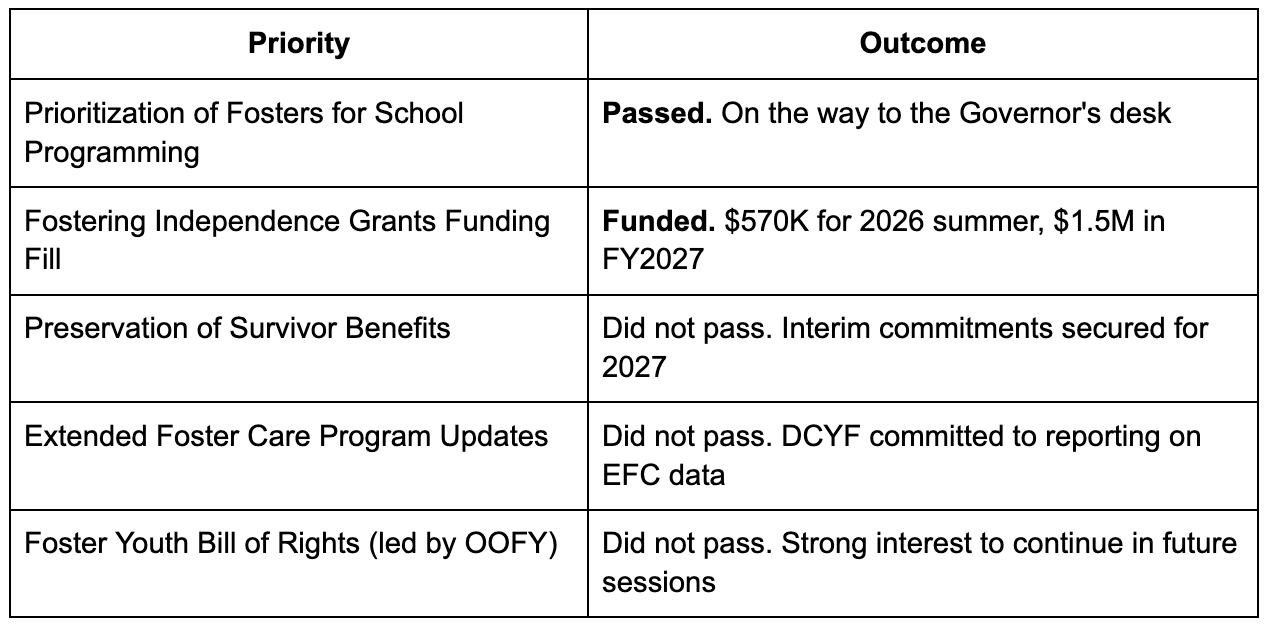
Session Outcomes at a Glance
Fosters Get Priority Access to Before- and After-School Programs
Passed. Because of your support, our before- and after-school programming bill (HF3714/SF4879) was incorporated, as amended, into the final Conference Committee Report for SF4612. It secures children in foster care priority access to school district before- and after-school programs in Minnesota when there is a vacancy.
That means young people in foster care cannot be placed at the back of the line for the enrichment programs, support systems, and relationships that support their development. This is practical. It is meaningful. And it happened because our Village showed up. The bill is on its way to the Governor's desk for signature.
We send deep gratitude to Representative Clardy, Senator Hoffman, and our testifiers for seeing this bill through to the end, and a special shoutout to Yanni, Zoua, and Osahon for their incredible leadership. It is because of your relationship-building and dedication that this bill will impact generations of Fosters in care.
Read the final bill language: Conference Committee Report on SF4612, Lines 142.20 to 142.28
Fostering Independence Grants: The Funding That Keeps College Accessible
Did not pass. SF4360/HF4206 proposed updates to Minnesota's Extended Foster Care (EFC) program aimed at improving supports for young adults transitioning out of foster care. The provisions were not included in final enacted legislation. The EFC reporting language was amended into the Senate's Health and Human Services bill before ultimately not making it into the final package, a reminder that end-of-session negotiations can shift quickly, and even broadly supported provisions can fall out in the final hours.
What is next: We received confirmation from leadership at the Minnesota Department of Children, Youth & Families that the department will move forward with including extended foster care exit and demographic data in either a separate report or future annual out-of-home placement and permanency reports, with a presentation specifically focused on EFC data. We have strongly encouraged DCYF to keep this data in a standalone report. When EFC data gets embedded in a larger document, it gets lost, and Fosters, and frankly all Minnesotans, deserve a clear, accessible entry point that shows exactly who this state investment serves, whether it is working, and where reforms are needed.
We are grateful to have partnered with the Youth Leadership Council on this bill and are excited to keep building together. Shoutout to Yanni and Youth Leadership Council members for continually coming back to the drawing board this session. Half the work is getting people to listen, and you did. Onward we go.
Foster Youth Bill of Rights
Did not pass. SF3154/HF3024, which proposed a comprehensive Bill of Rights for Minnesota foster youth, an effort led by the Office of the Foster Youth Ombudsperson (OOFY), did not pass this session, and its provisions were not included in final legislation.
Minnesota remains one of only five states without a foster youth bill of rights in statute, code, or agency policy. What we heard throughout the session was encouraging: there is strong interest in continuing this effort, and we will keep supporting OOFY as this work moves forward. Shoutout to Lexi and the OOFY team for your hard work and advocacy this session. Your efforts are deeply appreciated and far from lost.
Funded. The Fostering Independence Grants (FIG) program covers the full cost of attendance for eligible Minnesota Fosters under the age of 27. Established through legislation passed in 2021, the program has seen growing participation and demand, resulting in a budget shortfall in recent years.
This session, efforts led by Senator Rarick and Representative Rarick focused on securing additional funding to sustain the program. $570,000 was appropriated for the 2026 summer term, and an additional $1.5 million is appropriated from the general fund in fiscal year 2027. That means Fosters who were counting on this support can count on it.
Their leadership and commitment help ensure Fosters can continue pursuing higher education with the critical support they need.
Read the funding language: Conference Committee Report on HF4252, Lines 46.16 to 46.25
Did FIG change your path? We are collecting short testimonials from Fosters who have benefited from the program. Your story helps us protect this support for every Foster who comes after you. Reach out at advocacy@fosteradvocates.org to share your FIG story.
Preservation of Survivor Benefits for Fosters
Did not pass. SF4635/HF4872, which would preserve survivor benefits for Fosters, was not included in any final legislation this session.
For six years, Fosters, advocates, our Village, and partners across Minnesota have worked to end the practice of counties and agencies taking Social Security survivor and disability benefits belonging to Fosters, using those funds to reimburse the cost of care, often without young people knowing, and without anything being saved for their futures. In 2025, a two-year state-commissioned study confirmed what Fosters have been saying all along, identifying an estimated $3 million in benefits being diverted from young people.
What we learned: Getting to a durable bill will require tighter alignment around how these funds are protected, the fiscal impact, and how counties are supported through the transition. That alignment was not fully in place in time this session.
What is next: We secured commitments from Senator Wiklund, legislative staff, leadership at the Minnesota Department of Children, Youth & Families, the Governor's office, and county partners to continue working together during the interim toward shared bill language and a solution that can move successfully in 2027. Shoutout to Osahon, Aidan, Christopherson Advocates, and Hoang for your dedicated time to this issue. We remain focused and committed to ending this practice. We are closer than we were before.