

Fall 2026 Leadership Opportunities
Foster Advocates is excited to announce our Fall 2026 leadership opportunities for Minnesota Fosters. We have three groups opening this fall: the 2026-2027 College Committee, the 2026 FCC Summit Advisory Workgroup, and the 2026-2027 Psychotropic Drug Research Council. Each one has a different time commitment, timeline, and focus, so please read the descriptions below to find the right fit and confirm you are available for the meeting dates. You can apply to more than one. The application asks you to rank the groups you are interested in.
All leadership roles are paid at $25/hour.
Key Dates
Deadline: Monday, August 24, 2026 at 11:59 PM
Applicant review and conversations: August 24-26
Everyone hears back by: Friday, August 28, 2026
Every applicant gets an answer, whether that is an invitation, a waitlist spot, or a no for this round.
Quick Tips Before Starting
Preview all program descriptions (listed and linked below).
Prep your answers elsewhere; this form only autosaves if you're signed in (Gmail account required).
Expect ~30 minutes to complete.
Aim for 100-300 words (short paragraph) on narrative questions
What to Expect
General leadership questions plus program-specific questions based on the groups you rank. This helps our team get to know you.
We select for connection to the group's purpose, willingness to collaborate and learn, schedule availability, and overall representation across foster care experience, geography, identity, and stage of education. We do not select for polished professional language, previous leadership experience, academic performance, or willingness to disclose personal history.
Every Group Starts With a One-Hour Paid Orientation
Everyone selected completes a required one-hour orientation before their first meeting. It is asynchronous, so you do it on your own time and at your own pace, and it is paid like any other leadership time.
It is short on purpose. There is nothing to study for and nothing to pass. It covers who Foster Advocates is and how your group fits into our larger work, what we expect from you, what you will learn and build, and what you can expect from us.
The Foster Advocates Foster to Foster Portal is open, and registration is part of the application process.
Please complete your portal registration when you apply. That is where we collect additional information so we can connect you to identity-specific community spaces, resources and referrals, and peer mentorship and support networks. Leadership opportunities and updates are shared through the Foster to Foster Portal.
Not available for leadership opportunities right now, or not seeing one that fits? That's okay. We'd prefer you apply when you can fully commit to the time required, so you get the most out of it and our community benefits from your consistent presence and lived experience expertise.
-
Overview
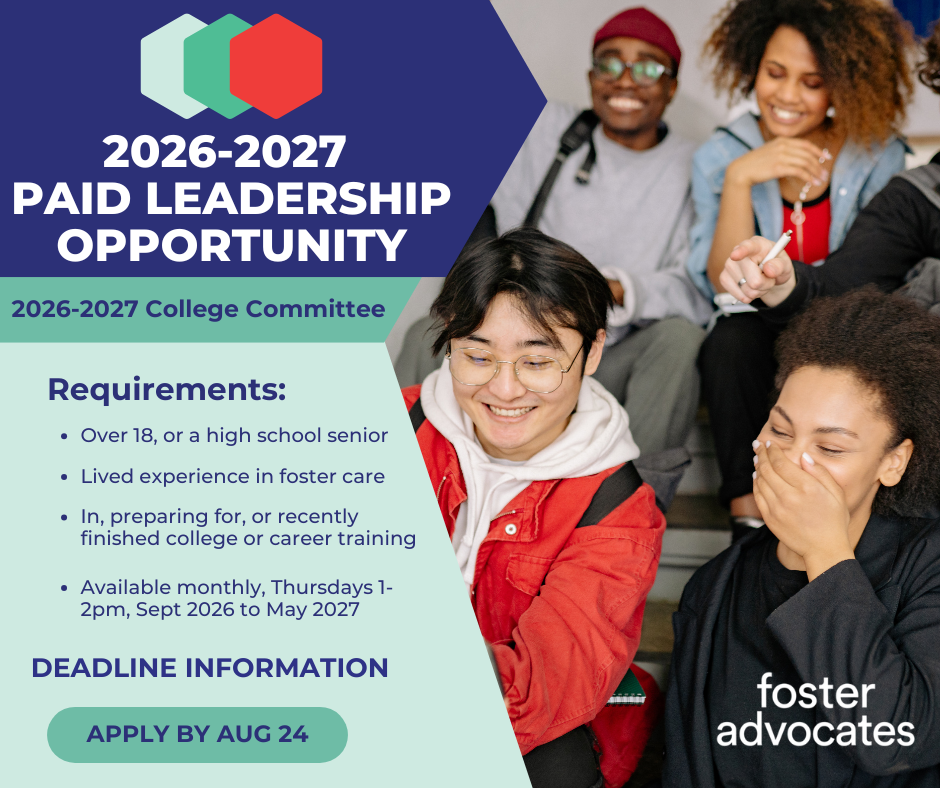
The College Committee is one of Foster Advocates' core leadership groups. The Committee represents Foster student voice in our Education & Opportunity Program's postsecondary work, especially the Fostering College Connections initiative. Members use their experiences and ideas to shape program priorities, strengthen resources and events, advise institutional partners, and improve how Minnesota's education and training systems support Fosters.Timeline: September 2026 through May 2027. Schedule and capacity checks happen before the spring semester.
Eligibility: Minnesota Fosters currently in a college, university, career training, apprenticeship, or certificate program, OR actively preparing to begin one within the next year, OR who graduated from or completed one within the past two years. High school seniors may apply if the daytime meeting schedule works for them; applicants under 18 need guardian permission before participating.
Size: Five to eight members, selected to represent different education pathways, institutions, regions, identities, and stages of the education journey.
Pay: $25/hour, estimated 1-3 hours per month.
Staff Lead: Sarah
Required orientation: One hour, asynchronous, completed by Wednesday, September 2.
Meeting Dates
All meetings are virtual, 1-2 pm.
Thursday, September 3, 2026 — first meeting
Thursday, October 1, 2026
Thursday, November 5, 2026
Thursday, December 10, 2026 — winter meeting option 1
Thursday, January 7, 2027 — winter meeting option 2
Members attend one end-of-year meeting, December 10 or January 7, to work around school, work, and holiday schedules.
Thursday, February 4, 2027
Thursday, March 4, 2027
Thursday, April 1, 2027
Thursday, May 6, 2027 — celebration and wrap-up
Additional dates for technical assistance sessions, Communities of Practice, Empower & Thrive, and presentations are shared in advance. Participation is based on your interests, availability, and an established role or learning goal.
Paid time includes committee meetings, preparation and follow-up, approved resource review or project work, and planned participation in events, presentations, TA, or CoP sessions. Additional work is scoped and approved by staff in advance, with the expected outcome, timeline, and available paid hours confirmed in writing before you start.
-
Overview
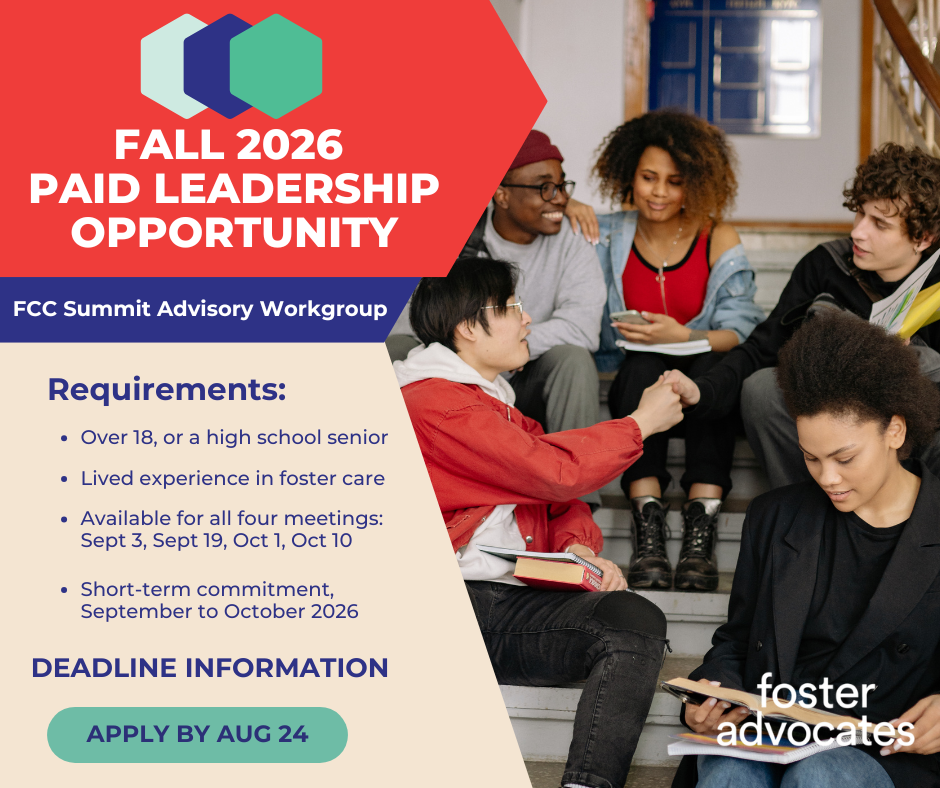
The Summit Advisory Workgroup shapes the 2026 Fostering College Connections Summit, a statewide gathering for college and community professionals who support Fosters on their journeys to, through, and beyond college. Foster leaders bring their ideas, experiences, and feedback so the Summit reflects what students with foster care experience actually need.
Timeline: September through October 2026. This is our shortest commitment this fall.
Eligibility: Minnesota Fosters currently in a college, university, career training, apprenticeship, or certificate program, OR actively preparing to begin one within the next year, OR who graduated from or completed one within the past two years. High school seniors may apply if the daytime meeting schedule works for them; applicants under 18 need guardian permission before participating.
Size: Five to six Foster Advisors, selected to represent different education pathways, institutions, regions, identities, and stages of the education journey.
Pay: $25/hour. Four virtual meetings plus about one hour of preparation before each.
Staff Lead: Ke'Nija
Required orientation: One hour, asynchronous, completed by Wednesday, September 2.
Details
In October 2026, Foster Advocates hosts the first statewide Fostering College Connections Summit. Over the past two years, FCC has partnered with colleges across Minnesota to make the higher education system, and the pathways into it, more Foster-informed. The Summit is the first time all of those partners are in one room.
Summit Advisors should care about improving higher education for Foster students and be able to attend all four planning meetings. The Workgroup identifies the topics the Summit should address, gives feedback on sessions and activities, reviews the resources and tools going to college and community partner staff, and names the gaps that still need attention.
Before each meeting, Advisors review materials including draft Summit plans and participant resources, reflect on discussion questions, and come ready to share feedback.
During meetings, Advisors review Summit sessions and activities, identify priority topics and remaining gaps, and give feedback on participant resources.
Because this is a short-term group, staff collect feedback after the Summit to understand what worked and what should change for future Workgroups, and help Advisors document the contributions and skills they demonstrated.
Required Meeting Dates
All meetings are on Zoom. Plan about one hour of preparation before each.Thursday, September 3 | 4:00-5:00 PM — kickoff, introductions, and Summit priorities
Saturday, September 19 | 10:00-11:00 AM — review Summit tracks and session ideas
Thursday, October 1 | 4:00-5:00 PM — review resources and identify remaining gaps
Saturday, October 10 | 10:00-11:00 AM — final Summit review and debrief
Optional: Summit Day Leadership Role
Advisors who are interested may also work the Fostering College Connections Summit on Wednesday, October 28, 2026. Up to four Fosters are selected for these paid roles, roughly 8 hours at $25/hour:
Welcoming participants
Supporting breakout sessions
Facilitating small-group discussions
Sharing lived experience when appropriate
Giving real-time feedback to colleges during action planning
Assisting Foster Advocates staff throughout the day
-
Overview
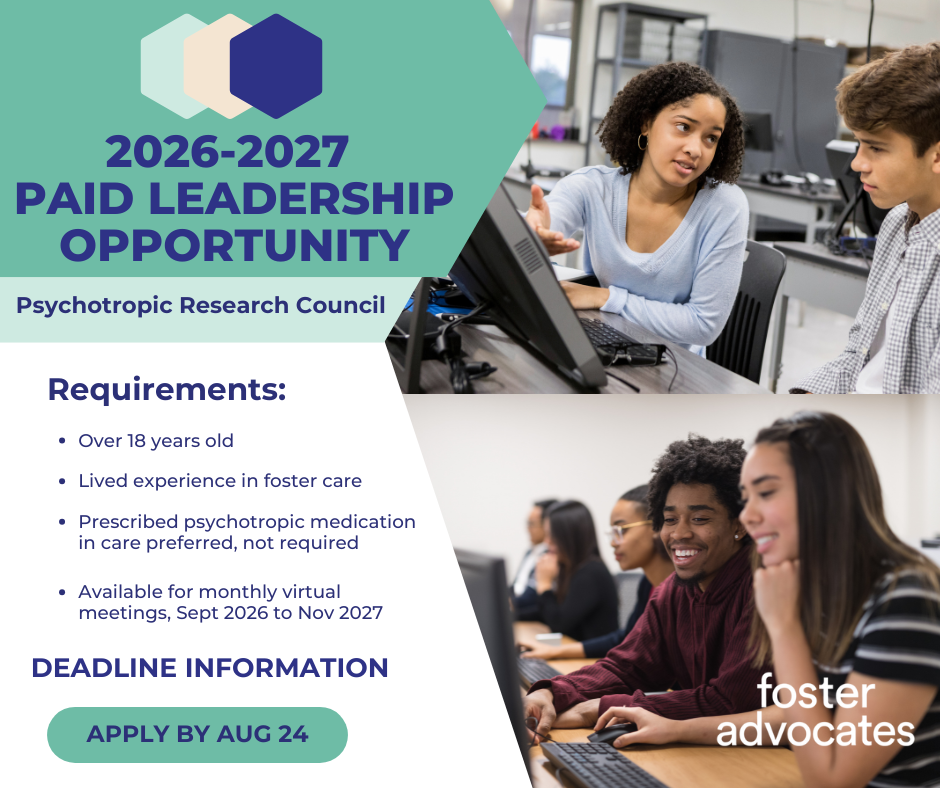
This Research Council guides our 2026-2027 psychotropic drugs research partnership with the Institute on Community Integration at the University of Minnesota, from research design through implementation, data interpretation, deliverables, and next-step recommendations. Council members' ideas and expertise make sure Foster voices are centered across the research process.Timeline: September 2026 through November 2027, with capacity check-ins in January and June 2027. This is our longest commitment this fall.
Eligibility: Minnesota Fosters age 18 and up with an interest in informing research and reviewing data. Personal experience being prescribed psychotropic drugs while in foster care is preferred but not required.
Size: Five to six members, selected to represent different experiences in care, with psychotropic drugs and mental health supports, and across regions and identities.
Pay: $25/hour, estimated 2-4 hours per month.
Staff Lead: TBA
Required orientation: One hour, asynchronous, completed within two weeks of confirming your seat and before the first Council meeting.
You will never be required to share your own medication or mental health history in this role.
Details
The impact of psychotropic drugs — antidepressants, antianxiety medication, antipsychotics — on Minnesota Fosters has been a priority on our research agenda since 2021, and was confirmed as a priority through MN Promise. We received a grant in partnership with researchers at the University of Minnesota to dig into it.
This research asks whether and how Fosters are overprescribed medication compared to their peers, and what Fosters' experiences with psychotropic medication have actually been in terms of consent, medication management, broader mental health treatment, and what happens when you transition out of care.
The Research Council keeps Foster voice and expertise at the center of that work: developing and confirming research methods and questions, outreach for data collection, making meaning of the data, and shaping how results and recommendations get communicated.
Research questions
Q1: Are Minnesota Fosters overprescribed psychotropic medications compared to their peers? Does that vary by age, guardianship status, region, or placement setting? Answered using existing data from the National Core Indicators dataset.
Q2: What are Fosters' experiences with psychotropic medications compared to other forms of treatment? How do Fosters experience agency over their medications, and how does that affect their confidence managing them? What is it like to access your medication history and management plan, both in care and as you leave care? Answered through surveys, focus groups, or interviews — the Council helps decide which.
No previous research experience is required. Basic training on research terms and processes is provided to all Council members, with additional resources available whenever you want them.
Our leadership principles
Our leadership work is grounded in these guiding principles, co-created with early leaders in our network.